The TBM Speed Cowl Development History
Since their introduction in 1991, the TBM 700’s and later 850’s have been known as the highest performing single engine turboprops. In 2014 Daher updated the cowling of the new TBM’s to one that offered boundary layer relief similar to cowlings developed by American Aviation Inc. in the early 2000’s for the Cheyenne and King Air models. Since then, numerous TBM owners have contacted American Aviation and asked if we could develop a ram air cowling for older TBM’s. At the time we were developing a new cowling for the Pilatus PC-12 aircraft which was certified in 2019. Shortly thereafter, American’s engineering team was tasked to look at the TBM design and see how improvements could be made to that aircraft.
With the 700 and 850 cowlings being an old design, without boundary layer relief, it made sense that the airplanes would benefit from a more modern and efficient inlet. With the aid of computer generated flow visualization programs, a new prototype design incorporating cutting-edge technology was developed and flight tested, confirming optimum performance could be achieved.
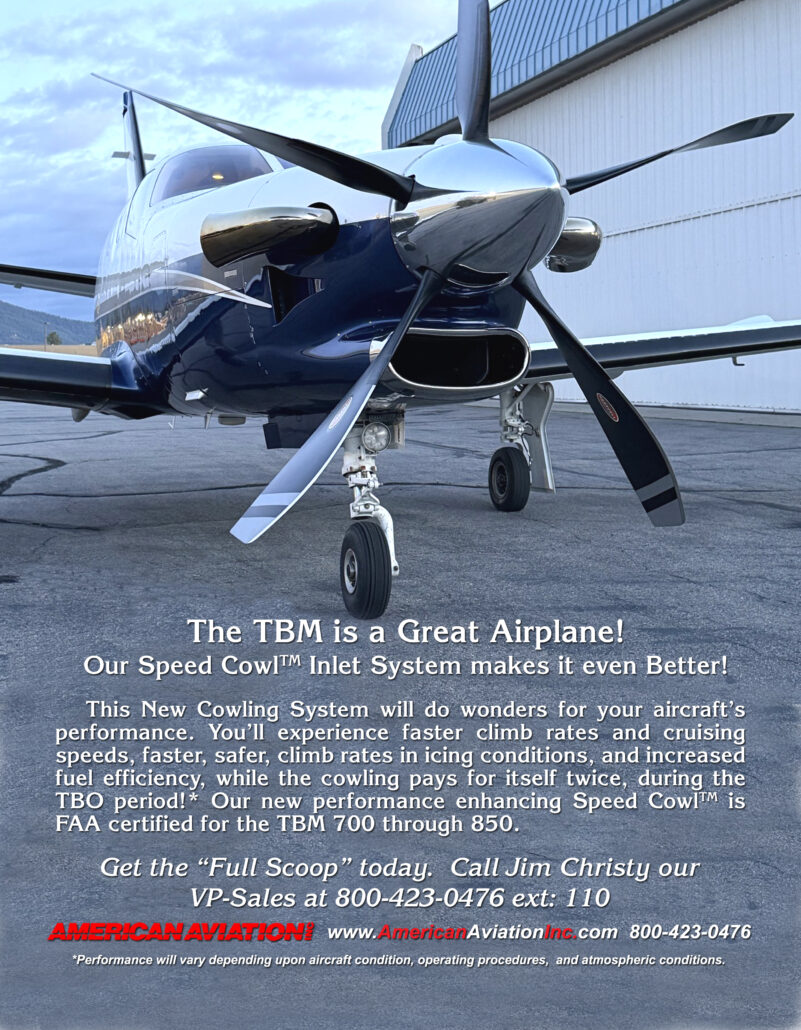
In 2020 we committed to manufacture an all new cowling / inlet system from carbon fiber and obtain FAA and EASA approval. This lead to the manufacture and FAA certification of a Speed Cowl for the TBM which combined a cowling inlet with maximum recovery of high-velocity ram air, and internal ducting that was aerodynamically designed to minimize flow losses to the engine’s plenum. The results were higher available torque at the same ITT settings, which significantly improved the performance of both the Pratt and Whitney PT6A-64 and -66D turbine engines.
Speed Cowl™ has been flight tested in multiple flight configurations, climb, cruise at various altitudes, with the inertial separator door open and closed—all at varied torque and ITT settings.
The results showed the cruise true airspeeds and climb rates increased significantly in the flight levels, without exceeding any aircraft or engine limitations. The performance improvements naturally depend on the altitude, outside air temperature and ITT settings used. New performance charts are provided due to the increased efficiency of the cowling / inlet system.